The Septenary Constitution, the Philosophical Bias
The soul is most like the divine, immortal, intelligible, and uniform.
— Plato, Phaedo, 80b
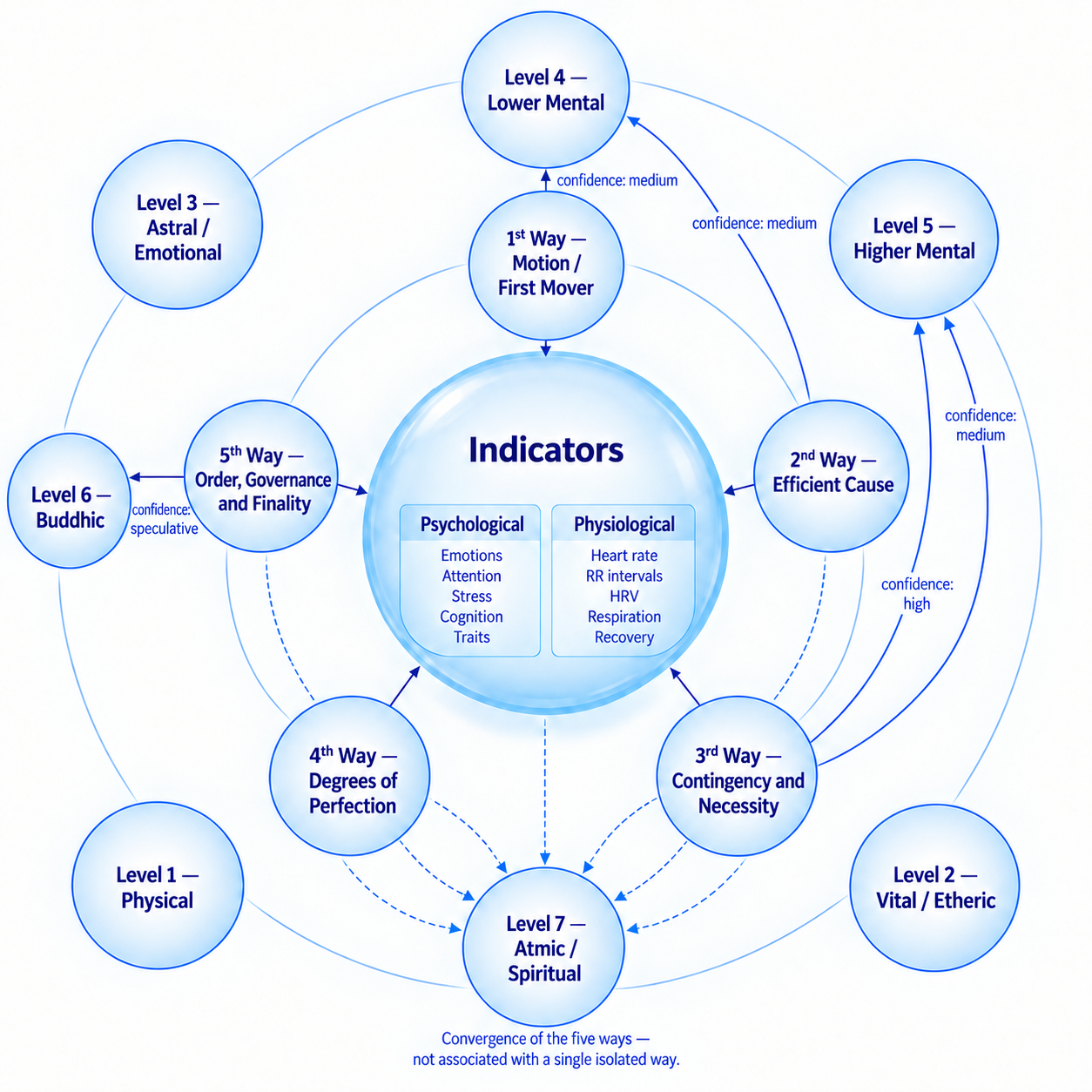
The septenary constitution is a metaphysical model of the levels of being and consciousness (Nova Acrópole, 2023), physical, vital/etheric, astral, lower mental, higher mental, buddhic and atmic/spirit. Each of the study’s psychometric dimensions was read against this ladder, not as a scientific claim but as an interpretative bridge:
| # | Body / principle | Nature | Function in consciousness |
|---|---|---|---|
| 1 | Physical Body (Sthula Sharira) | Dense, material | Concrete action, survival, objective performance |
| 2 | Vital/Etheric Body (Prana/Linga Sharira) | Energetic | Vitality, disposition, the energy sustaining physical life |
| 3 | Astral Body (Kama Rupa) | Emotional | Desires, emotions, affects, pleasure/displeasure |
| 4 | Lower Mental Body (concrete Manas) | Concrete mind | Practical reasoning, everyday cognitive control, immediate planning |
| 5 | Higher Mental Body (abstract Manas) | Abstract mind | Values, commitment, long-term judgment, identity |
| 6 | Buddhic Body (Buddhi) | Intuitive | Intuition, existential meaning, flow/absorption, meaning-making |
| 7 | Atmic Body/Spirit (Atma) | Spiritual | Transcendent will, ultimate purpose, full self-realization |
The soul is the actuality of a natural body that possesses life in potentiality.
— Aristotle, De Anima, II.1
Reading the instruments through that ladder: Vigor (Engagement) maps to the Vital/Etheric level almost by definition, it is literally energy applied to an activity. Satisfaction With Life and Job Satisfaction sit at the Astral level, affective judgments about desire satisfied or unsatisfied. Control (Hardiness and CAAS) and Perceived Control of Life land on the Lower Mental level, concrete, practical agency. Commitment (Hardiness), Dedication (Engagement) and Confidence/Curiosity (CAAS) climb to the Higher Mental level, identity-level, abstract judgment about the future. Absorption (Engagement, the flow state), Challenge (Hardiness) and Concern (CAAS) reach the Buddhic level, meaning-making rather than task execution. A handful of context blocks (organizational anomie, perceived bureaucracy, curricular year) were deliberately left out of the table: they describe the environment around the person, not a level of the person’s own consciousness.
Relation table: SPSS instruments/dimensions × level of consciousness
The full correspondence, instrument by instrument, dimension by dimension, with the justification behind each row, including the Physical and Atmic/Spirit levels left out of the summary above:
| Septenary level | Instrument (SPSS) | Dimension → computed column | Recorded behavior | Justification for the correspondence |
|---|---|---|---|---|
| 1. Physical | Burnout Scale (hypothesis, ef1–ef18) | Emotional Exhaustion (no computed column in the .sav, see schema gap below) | Exhaustion, fatigue, drop in objective performance | Exhaustion first manifests as a collapse of physical/bodily energy, a physical symptom before an emotional one |
| 2. Vital/Etheric | Engagement Scale | Vigor → ENGAGvigor | Disposition, energy, willingness to invest effort in studying | “Vigor” is by definition vital energy applied to an activity, a direct mapping |
| 2. Vital/Etheric | Positivity Ratio Scale | Positive Emotions (physiological: joy, interest) → EmocPos (part) | Positive energetic activation | High-activation emotions (joy, interest) have a strong vital/energetic component |
| 3. Astral | Satisfaction With Life Scale | Single index → SATISFVIDA | Global affective evaluation of one’s own life | Satisfaction is an affective judgment, astral body (desire satisfied/unsatisfied) |
| 3. Astral | Job Satisfaction Scale | Single index → SATISFTRAB | Pleasure/displeasure with the occupational activity | Same as above, affect tied to a specific object (work) |
| 3. Astral | Positivity Ratio Scale | Positive/Negative Emotions → EmocPos / EmocNeg | Emotional repertoire (joy, gratitude, sadness, fear, anger…) | Pure emotional core, this is literally the measure of the astral body |
| 3. Astral | Personal Satisfaction | Single item → SatPes | Subjective contentment with oneself | Self-directed affect |
| 4. Lower Mental | Hardiness | Control → HARDcontrole | Belief in being able to influence everyday events | Control is a concrete cognitive function, “I think, therefore I can act on this” |
| 4. Lower Mental | Perceived Control of Life | Single item → CtrlVi | Practical sense of mastery over one’s own routine | Concrete cognitive judgment about personal agency |
| 4. Lower Mental | Career Adapt-Abilities Scale | Control → ACcontrole | Practical planning and decision-making about one’s career | Practical reasoning applied to a concrete goal (career) |
| 5. Higher Mental | Hardiness | Commitment → HARDcompromis | Engagement with values and life purpose (not just the task) | Commitment goes beyond the concrete, it is adherence to a meaning/identity |
| 5. Higher Mental | Engagement Scale | Dedication → ENGAGdedicac | Enthusiasm, pride, meaning attributed to the student role | “Dedication” is an investment of identity, not just energy (vital) |
| 5. Higher Mental | Career Adapt-Abilities Scale | Confidence → ACconfianc | Self-efficacy projected onto one’s professional future | Abstract self-judgment over time, the abstract mind |
| 5. Higher Mental | Career Adapt-Abilities Scale | Curiosity → ACcuriosid | Exploring alternatives, openness to possibilities | Exploratory/abstract thinking, not tied to an immediate action |
| 6. Buddhic (intuitive) | Engagement Scale | Absorption → ENGAGabsorc | Flow state, losing track of time while studying | Absorption/flow is described in the literature as a quasi-transcendent state of subject-activity unity, a classic correspondence with the Buddhic body |
| 6. Buddhic (intuitive) | Hardiness | Challenge → HARDdesafio | Ability to draw meaning and growth from adversity | Turning difficulty into meaning is an intuitive/meaning-making operation, beyond practical reasoning |
| 6. Buddhic (intuitive) | Career Adapt-Abilities Scale | Concern → ACpreocup | Future orientation with a sense of existential continuity | “Concern” here is an integrated temporal outlook, close to the intuitive perception of purpose |
| 7. Atmic/Spirit | Block an1–an11 (undocumented, hypothesis) | Personal Fulfillment → RealizPess | Sense of ultimate fulfillment, purpose achieved | The name and semantics (“personal fulfillment”, high mean = 4.03) suggest the highest level of meaning, beyond the abstract mind |
Not mapped to the 7 levels
These blocks describe the environment or organization around the person, not a principle of the individual’s own constitution, they are left out of the table above because they are not a “body” or “level of consciousness” of the person, but external pressure on them:
| Block | Computed column | Why it is left out |
|---|---|---|
an1–an11 (partial) | AnoOrg (Organizational Anomie) | Perception about the organization, not a state of consciousness of the individual |
an1–an11 (partial) | SucProfFin (Professional/Financial Success) | External socioeconomic indicator, not an internal experience |
an1–an11 (partial) | CondSocie (Social Standing) | Perception of social status, a context variable |
red1–red5 | RedTap (Red Tape/perceived bureaucracy) | Judgment about the institutional environment, not about oneself |
ano | — | Demographic variable (curricular year), not a psychological construct |
The Septenary Constitution relational model
The septenary layer is loaded into its own catalog and mapping tables (GDX_PSY_SEPTENARY_*): a fixed catalog of the seven levels, linked to GDX_PSY_INSTRUMENT and its constructs through a dedicated mapping table, so that any instrument’s dimensions can be cross-referenced against the septenary ladder without touching the core psychometric schema.
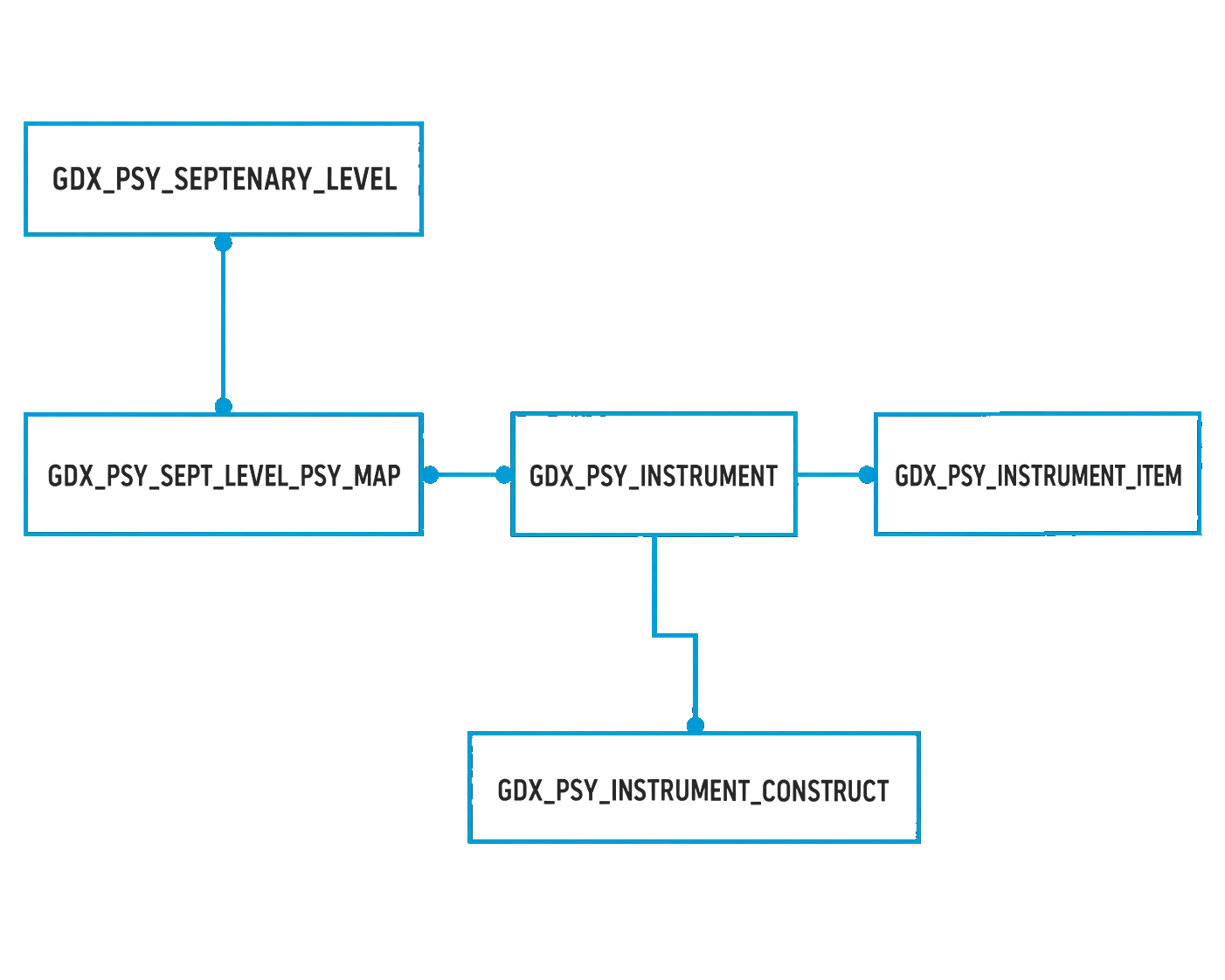
GDX_PSY_SEPTENARY_* relational model behind the Septenary Constitution layer.This is an excerpt covering the philosophical bias of the instrument. Read the full article, GoDataX Human 7: A Multidimensional Measuring Instrument for Human Evolution, for the psychological, physiological, metaphysical, energetic and remaining sections.