DataScience as a measuring instrument in the context of human evolution
Implementing GoDataX as a DataScience and AI Model that will improve psychometrics
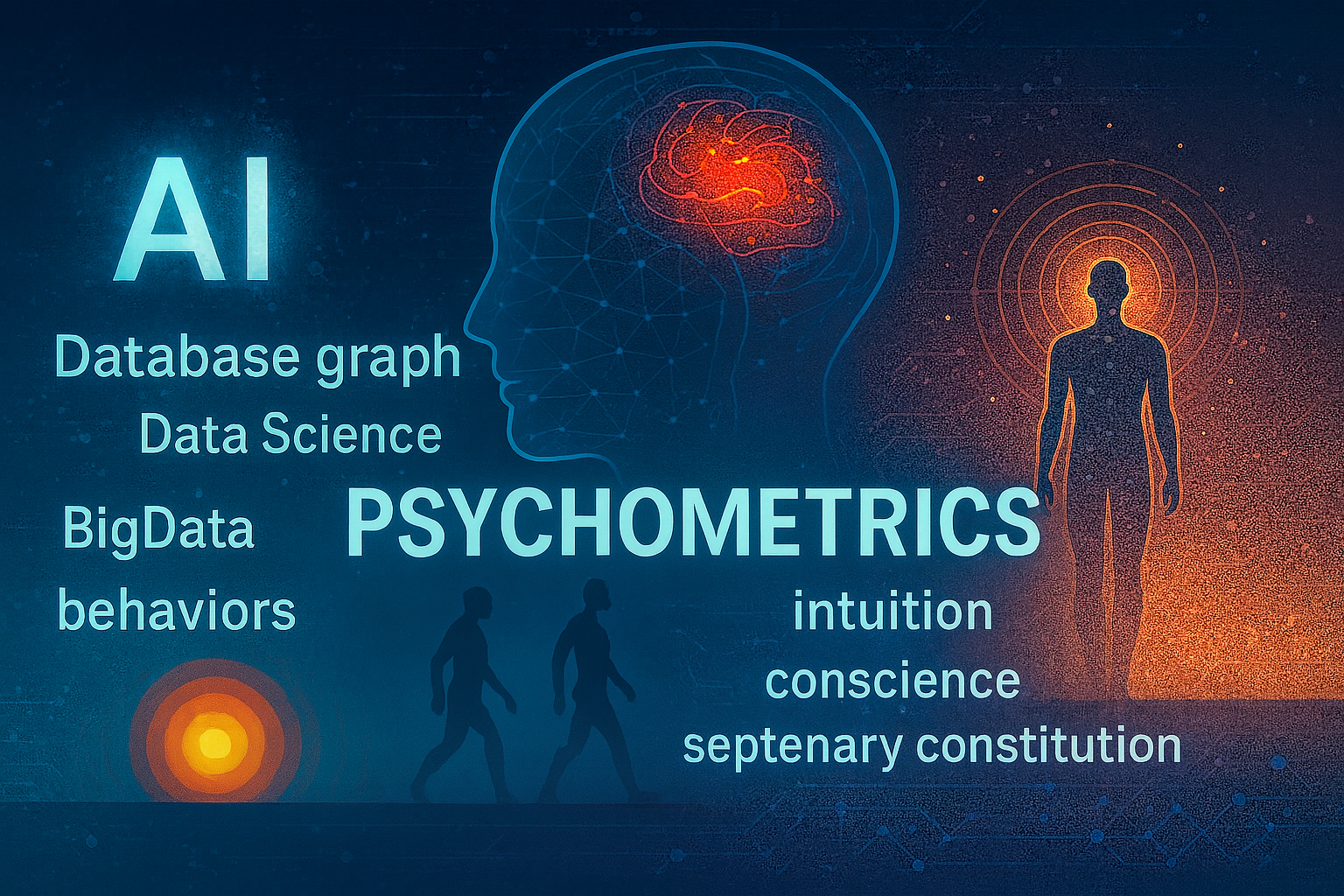
The intention of this social project is to use technologies such as Big Data, Graph Databases, Data Warehouses, Artificial Intelligence, and Data Science to enhance psychometrics, not only to measure behaviors but also to capture different levels of consciousness within the septenary constitution. Starting from the neurological levels pyramid, the goal is to identify positive and negative traits, correlate these behaviors, and understand how strongly they are connected through the KMO index, as well as to detect psychological and psychiatric patterns, including extreme behaviors. This will support professionals in identifying the most suitable treatments before initiating medication through psychiatric drugs. In essence, the purpose is to integrate Data Science, AI, and the science of consciousness to build bridges between human psychology, measurable behavior, and the deeper energetic structures that define who we are, helping people find their best paths and truly know themselves from the inside out too.
The Scientific-methodological challenge
The greatest challenge, and also its greatest achievement, is creating a reliable bridge between data and soul. Uniting the "Big Data of the brain" with the "Big Data of the human being" requires a new ethic, a new language, and a new form of science.
1-) Scientific-Methodological Challenge Measuring the Immeasurable: Consciousness and subjective states are complex, fluid, and context-dependent. Transforming them into quantifiable variables (even with the support of AI and psychometric scales) requires rigor and sensitivity. Hybrid Modeling: Correlating psychometric, clinical, and energetic data within a coherent mathematical framework, especially via KMO and factor analysis, requires a solid experimental design and ethical data curation. Scientific Validation: It will be necessary to prove that the models have statistical validity and psychological relevance, which implies longitudinal and comparative studies.
2-) Technological Challenge Integration of Multiple Sources: Behavioral, clinical, and energetic data in different formats (structured and unstructured) need to be harmonized in a Data Warehouse and graphs without losing context. Scalability and Privacy: Handling human and psychological data requires security, anonymization, and compliance (GDPR, HIPAA, etc.). Semantic interoperability: translating human meanings (emotions, archetypes, levels of consciousness) into graph structures and ontologies understandable by AI is an emerging and still challenging field.
3-) Philosophical-epistemological challenge Uniting science and spirituality: academia still tends to separate the measurable (science) from the experiential (spirituality). This project requires a new epistemic language, where data are bridges, not borders. Avoid reductionism: the risk is to "translate" consciousness into mere numbers, losing the qualitative dimension. The balance is to treat data as mirrors, not essences. Defining consciousness in operational terms, without emptying its mystery—this is one of the greatest challenges of modern science.
4-) Human-ethical challenge Consent and responsible use: psychological and psychiatric data are sensitive; use for predictive diagnosis must respect autonomy and ethics. Careful interpretation: The results should be used as supportive tools, not as substitutes for the human sensitivity of psychologists and psychiatrists. Social impact: Addressing levels of consciousness is ultimately about addressing human vulnerabilities—and this requires compassion, not just precision.
GodataX Social Project
The link learn more about Psychometrics