Analytical & Machine Learning Bias
Data Warehouse, the Analytical Bias
Nothing happens without a sufficient reason.
— Leibniz, Principle of Sufficient Reason
All of the below, psychometric scores, cardiac-coherence windows, septenary levels, chakras, and the Five Ways, converge into a unified Data Warehouse designed as a multidimensional analytical environment. Rather than simply storing data, the GoDataX Human 7 Data Warehouse integrates, structures, and relates heterogeneous sources across psychological, physiological, metaphysical, and energetic dimensions, enabling historical analysis, cross-dimensional correlations, pattern discovery, and deeper interpretation of human states. This architecture provides a consistent analytical foundation in which measurable scientific indicators remain distinguishable from philosophical and energetic interpretative models, while still allowing them to be explored together within the same metaphysical framework.
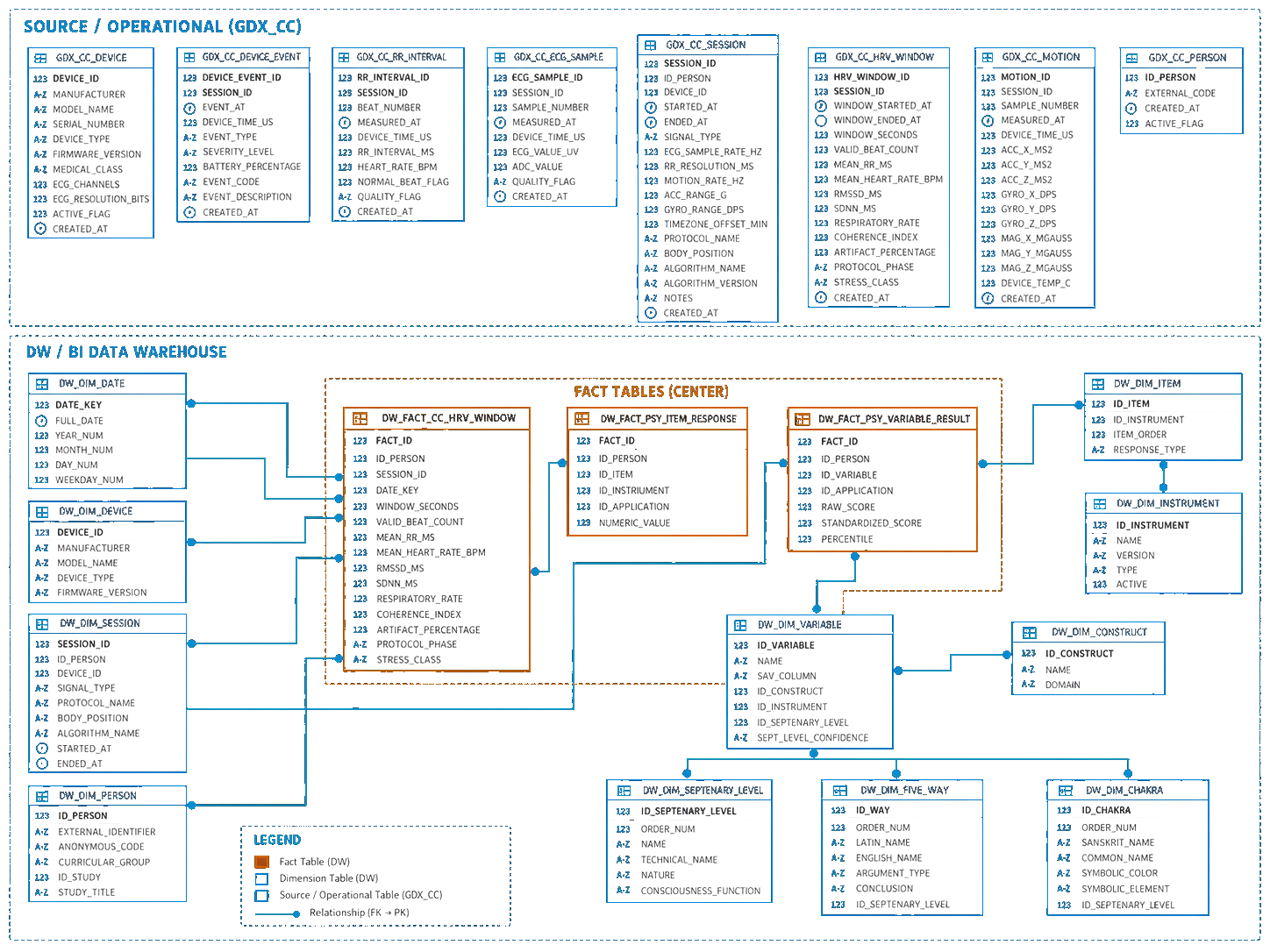
GDX_CC_* tables feeding a star schema of fact and dimension tables.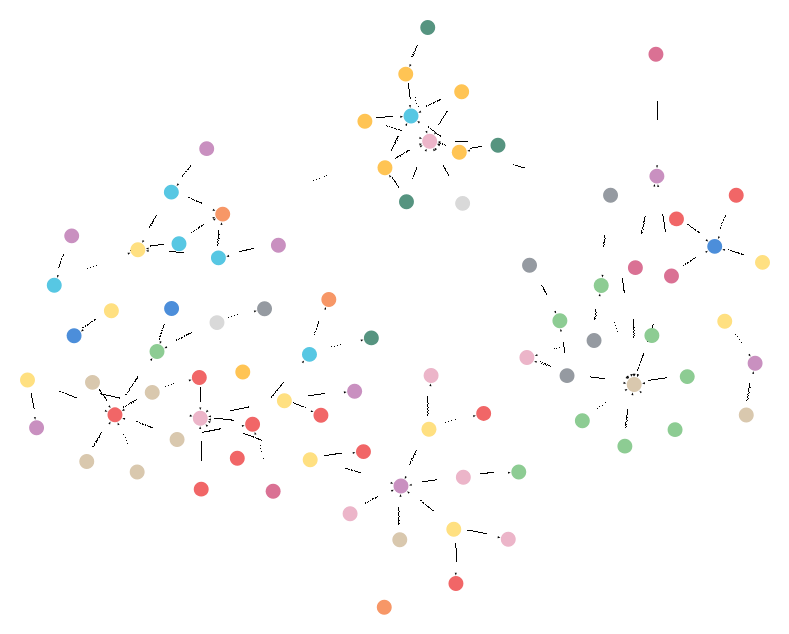
We know a thing fully only when we know its causes.
— Aristotle, Physics, II.3
The knowledge graph opens the door to two graph-native machine-learning passes over the same 55 nodes / 70 edges, scoped below with the Data Science Workflow Canvas (GDX_STRATEGIC_DISCOVERY).
1Problem Statement
Most psychometric variables in the graph already have a VARIABLE→LEVEL mapping, but every new variable added lands as “UNKNOWN” and reviewing each one by hand against all 7 septenary levels doesn’t scale.
2Outcomes/Predictions
For every “UNKNOWN” VARIABLE node, a ranked top‑3 list of candidate SEPTENARY_LEVEL targets with scores, not a single hard label.
3Data Acquisition
The Human 7 knowledge graph itself: 55 relational tables as nodes, 70 foreign keys as edges, with the existing VARIABLE→LEVEL mappings as ground-truth positives.
4Modeling
Neo4j GDS FastRP node embeddings (each node → a vector encoding its neighborhood) feed a classifier trained on existing mappings as positives vs. sampled non-edges as negatives.
5Model Evaluation
Cross-validate against the existing labeled mappings and surface only high-confidence predictions. Treated as a triage aid that ranks candidates for human review, not a classifier that replaces the judgment call.
6Data Preparation
Build FastRP embeddings for every VARIABLE and SEPTENARY_LEVEL node, then assemble the positive/sampled-negative edge training set from the existing mapping table.
knowledge.js with justification, the model suggests, a person decides).I know that I know nothing.
— Socrates (in Plato), traditional formulation of the Socratic method
1Problem Statement
The septenary/chakra level assignments were built by hand, one mapping decision at a time. Is there any independent, structural evidence in the graph itself that those groupings hold together?
2Outcomes/Predictions
No target label is predicted. The output is an unsupervised grouping of nodes into structural communities, to be compared visually against the existing septenary/chakra level colors.
3Data Acquisition
The same Human 7 knowledge graph as Model 1 (55 nodes, 70 edges), this pass runs with no labels used, so no mapping table is pulled in as training data.
4Modeling
Neo4j GDS Louvain community detection: unsupervised, modularity-based clustering that groups densely-connected nodes into communities (Community X · Y · Z…).
5Model Evaluation
Match, a community that is one solid level/chakra color supports that part of the interpretive mapping. Mismatch, a community spanning two levels, or a level split across two communities, is a prompt to revisit the construct definitions, not proof the framework is wrong. Clusters are structural, not causal.
6Data Preparation
Reuse the same graph projection built for Model 1; no positive/negative edge sampling is needed since Louvain runs unsupervised on graph structure alone.
Both canvases: GDX_HUMAN/10_gdx_machine_learning, see Septenary_Link_Prediction_and_Community_Detection.md for full detail.
Logical Architecture
End to end, the pipeline runs: SPSS psychometric analysis → load into the relational database → project into the knowledge graph → cross-reference with cardiac coherence, the septenary constitution, the Five Ways, and the chakras → surface through an LLM chatbot.
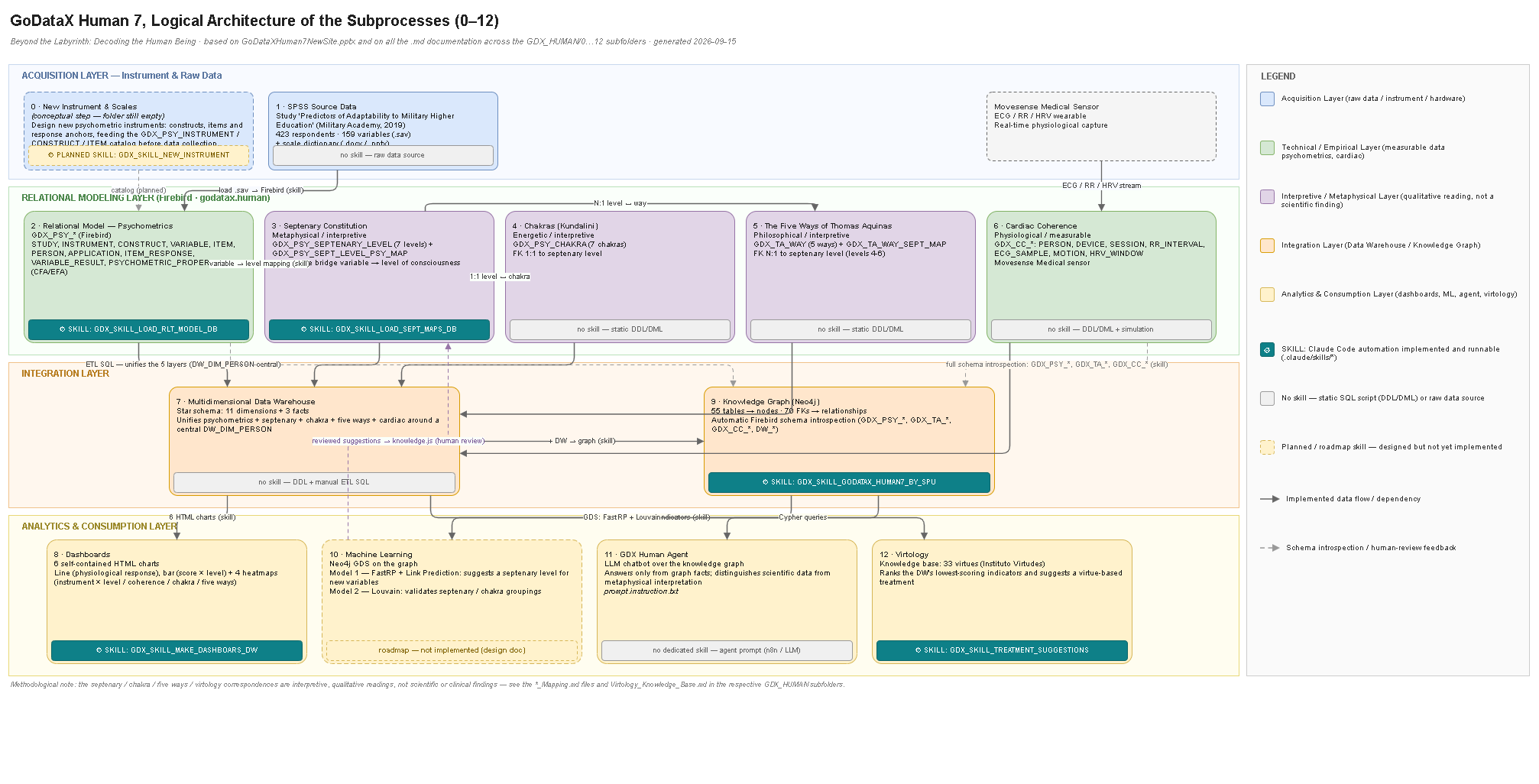
This is an excerpt covering the analytical and machine-learning bias of the instrument. Read the full article, GoDataX Human 7: A Multidimensional Measuring Instrument for Human Evolution, for the psychological, physiological, metaphysical, philosophical, energetic and remaining sections.