How to Contribute: The Trivium & Quadrivium Model for GoDataX Human 7ph
GoDataXh7 ph is built to be extended by clinicians, psychologists, philosophers, and classical-education specialists all have a real seat at the table, and this page is the entry point for that kind of contribution. It reconstructs the project's own Trivium & Quadrivium, contribution model the classical seven-liberal-arts framework the project borrows to keep every interpretive claim disciplined, whoever writes it.
1.0 The Trivium & Quadrivium Educational Model
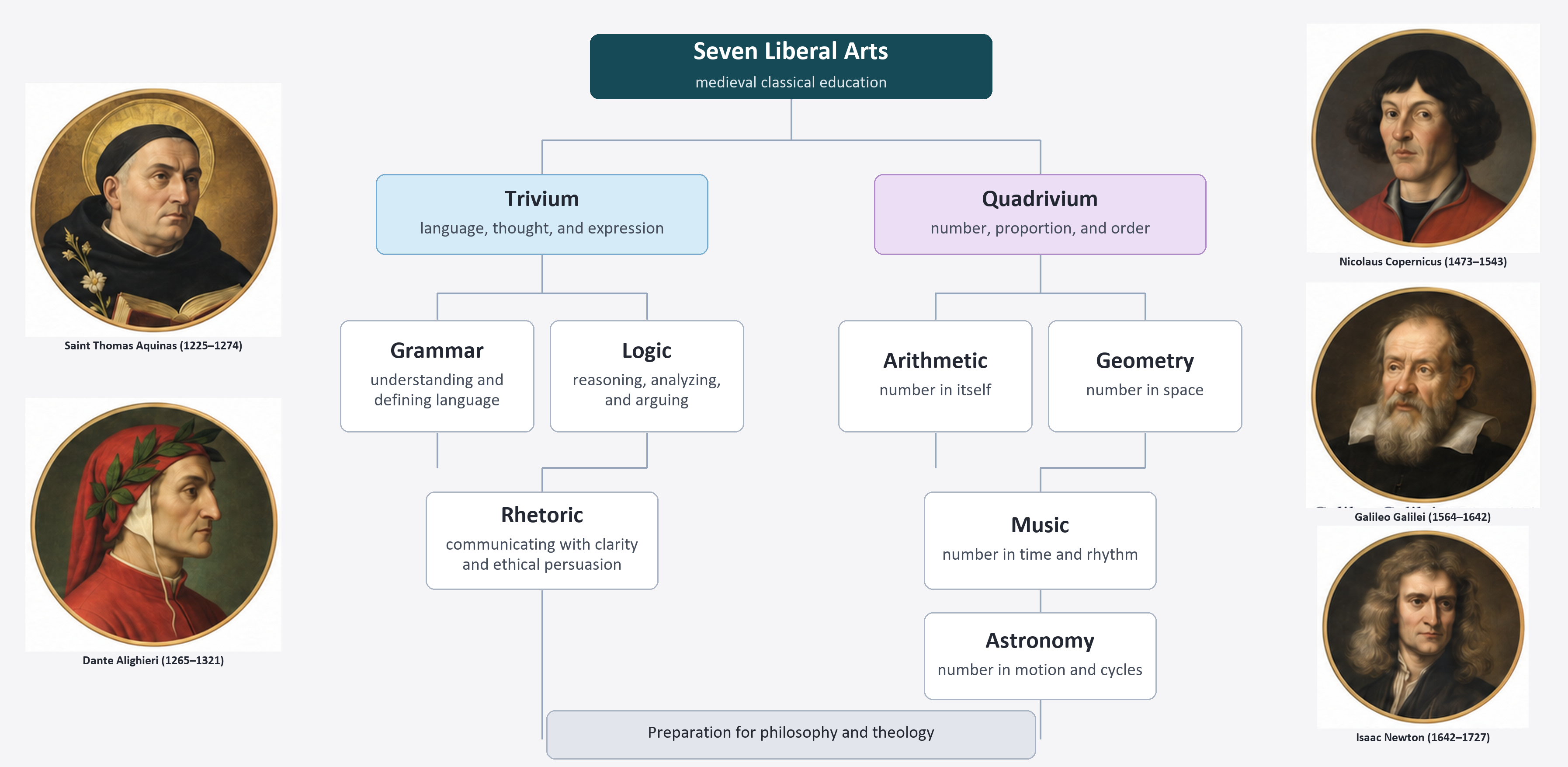
Long before it trained a profession, the medieval liberal-arts curriculum trained a mind. Its first stage, the Trivium, covered three language-and-thought skills: grammar, to understand ideas clearly; logic, to tell a sound argument from a fallacy; and rhetoric, to communicate that thinking clearly and persuasively. Its second stage, the Quadrivium, covered four number-and-order disciplines: arithmetic (number in itself), geometry (number in space), music (number in time and rhythm), and astronomy (number in motion and cycles). Together the seven arts prepared a student for philosophy and theology — and, not incidentally, shaped the education of Saint Thomas Aquinas, Dante Alighieri, Nicolaus Copernicus, Galileo Galilei, and Isaac Newton.
GDX_HUMAN7 reuses that same two-stage discipline as a contribution model, not just a history lesson. Before any interpretive claim (a philosophical reading, a virtue association, a clinical caveat) is written down, it passes through the Trivium: is the language precise, is the reasoning sound, is it communicated responsibly? Only then does the Quadrivium formalize it: what is measured, how is it structured, what is its rhythm and sequence, where does it sit in time. The three worked examples below apply that same discipline to an actual layer of the project.
2.0 Applying the Model: Three Worked Examples
All three examples break one concept into the same seven cells, Grammar, Logic, Rhetoric (Trivium) and Arithmetic, Geometry, Music, Astronomy (Quadrivium), so a contributor can see exactly which kind of discipline a given claim still needs. Together they cover the three layers used throughout the project: a measurement instrument, an interpretive layer, and a metaphysical variable (see §3.0).
2.1 Burnout Psychometric Assessment · Measurement Instrument
1Grammar
Instrument, items, scale, and population; timeframe, consent, and data-quality rules.
2Logic
Separate scores, absences, and consistency; contextual correlations, never causal inference.
3Rhetoric
Clear, ethical, non-clinical reporting.
4Arithmetic
Scores, means, percentiles, and trends.
5Geometry
Relational model and knowledge graph.
6Music
HRV, respiration, sleep, and recovery rhythms.
7Astronomy
Sessions, work cycles, and timeline.
2.2 Septenary Constitution · Level 1 · Physical-Etheric · Interpretive Layer
1Grammar
Define the Physical-Etheric level as body, vitality, physical presence, rest, and activity.
2Logic
Separate body data, self-reports, and context from the interpretive layer; no metaphysical-causal inference.
3Rhetoric
Descriptive, transparent, non-clinical reporting, with the limits of the interpretation clearly communicated.
4Arithmetic
Heart rate, HRV, sleep, activity, and self-reported fatigue.
5Geometry
Participant, session, instrument, indicator, and contextual event.
6Music
Respiration, heart-rate variability, sleep-wake rhythm, and recovery.
7Astronomy
Daily windows, weekly cycles, and session sequence.
2.3 Potency → Act (a philosophical variable) · Metaphysical Variable
1Grammar
Potency: the real possibility of actualization. Act: the realization or actual determination of that possibility.
2Logic
Organize the conceptual passage — possibility → conditions for actualization → realization — without treating it as scientific causality.
3Rhetoric
Make explicit that this is a philosophical, interpretive reading, distinct from measurement, diagnosis, or empirical validation.
4Arithmetic
Degrees, proportions, and differences between possibility and realization.
5Geometry
A relational map of states, conditions, transitions, and outcomes.
6Music
Rhythm, sequence, and intensity of transformations over time.
7Astronomy
Temporal order, cycles, and moments of potentiality and actualization.
3.0 Integration of Perspectives
Neither example stands alone. Every claim GDX_HUMAN7 publishes moves through three distinct, explicitly labeled layers, connected by mapping that is stated up front as interpretive, never causal:
Measurement Instrument §2.1
A psychometric burnout assessment: items, response scale, timeframe, and quality rules → scores for Emotional Exhaustion, Cynicism/Depersonalization, and Personal Accomplishment, each dimension analyzed separately.
Interpretive Layer §2.2
Physical-Etheric — Constitution Septenária, Level 1: body, vitality, physical presence. A philosophical reading identified as such; it never substitutes for physiological or clinical indicators.
Metaphysical Variable §2.3
Potency → Act: possibility of realization → actual realization. Not a score, a causal explanation, a diagnosis, or an empirical validation.
Each arrow above is a stated, reviewable mapping decision, not a statistically derived relationship. A mismatch is a prompt to revisit the mapping, never proof that the instrument or the interpretation is wrong.
The combined report stays legible because the three layers are never merged into one number:
- Psychometric evidence — instrument, items, scores, timeframe.
- Context and body — physiological indicators and self-reports, when available.
- Interpretive reading — philosophical layers, clearly identified as such.
4.0 Contribution Matrix by Role
Activities below still need to be broken down and further detailed, this matrix is a starting map for where each discipline plugs in, not a finished scope of work.
| Role | Contribution / Deliverables | Trivium applied | Quadrivium applied |
|---|---|---|---|
| Psychiatrist | Contribute to clinical review, safety criteria, and the limits of scale use and interpretation. Guide appropriate referrals when needed, without automating diagnosis or treatment. | Grammar: precise clinical language. Logic: differentiating sign, symptom, hypothesis, and diagnosis. Rhetoric: responsible communication of risk and limits. | Arithmetic: critical reading of scores and thresholds. Geometry: organizing multidimensional profiles without reducing the person to indicators. |
| Psychologist | Select and onboard new psychometric instruments. Evaluate scales, constructs, application, and interpretation. Develop Virtology as interpretive virtue suggestions tied to the assessed dimensions. | Grammar: defining constructs, items, and virtues. Logic: theoretical coherence and the limits of interpretation. Rhetoric: ethical, understandable feedback. | Arithmetic: scores, consistency, and statistics. Geometry: dimensional structure and profile visualization. |
| Philosopher | Build and review interpretive mappings between behavioral variables, levels of consciousness, the Septenary Constitution, and Thomas Aquinas's Five Ways. | Grammar: the historical sense of the concepts. Logic: coherence of the arguments and the line between evidence and interpretation. Rhetoric: rigorous philosophical communication. | Arithmetic: descriptive representation of degrees. Geometry: the architecture of levels and relationships in the graph. Astronomy: the historical context of order and motion. |
| Trivium & Quadrivium Specialist | Define the scope of each activity based on the seven liberal arts. Build a glossary, a training path, quality criteria, and materials for multidisciplinary collaborators. | Grammar: shared vocabulary. Logic: critical thinking and association criteria. Rhetoric: communication, training, and public presentation of the project. | Arithmetic: measures and proportions. Geometry: structure and relations. Music: rhythm and tempo. Astronomy: cycles and regularities. |
Looking for the full developer setup, environment variables, and skill-by-skill pipeline reference? See the GDX_HUMAN7 Source Development Kit.