The Five Ways, the Metaphysical Bias
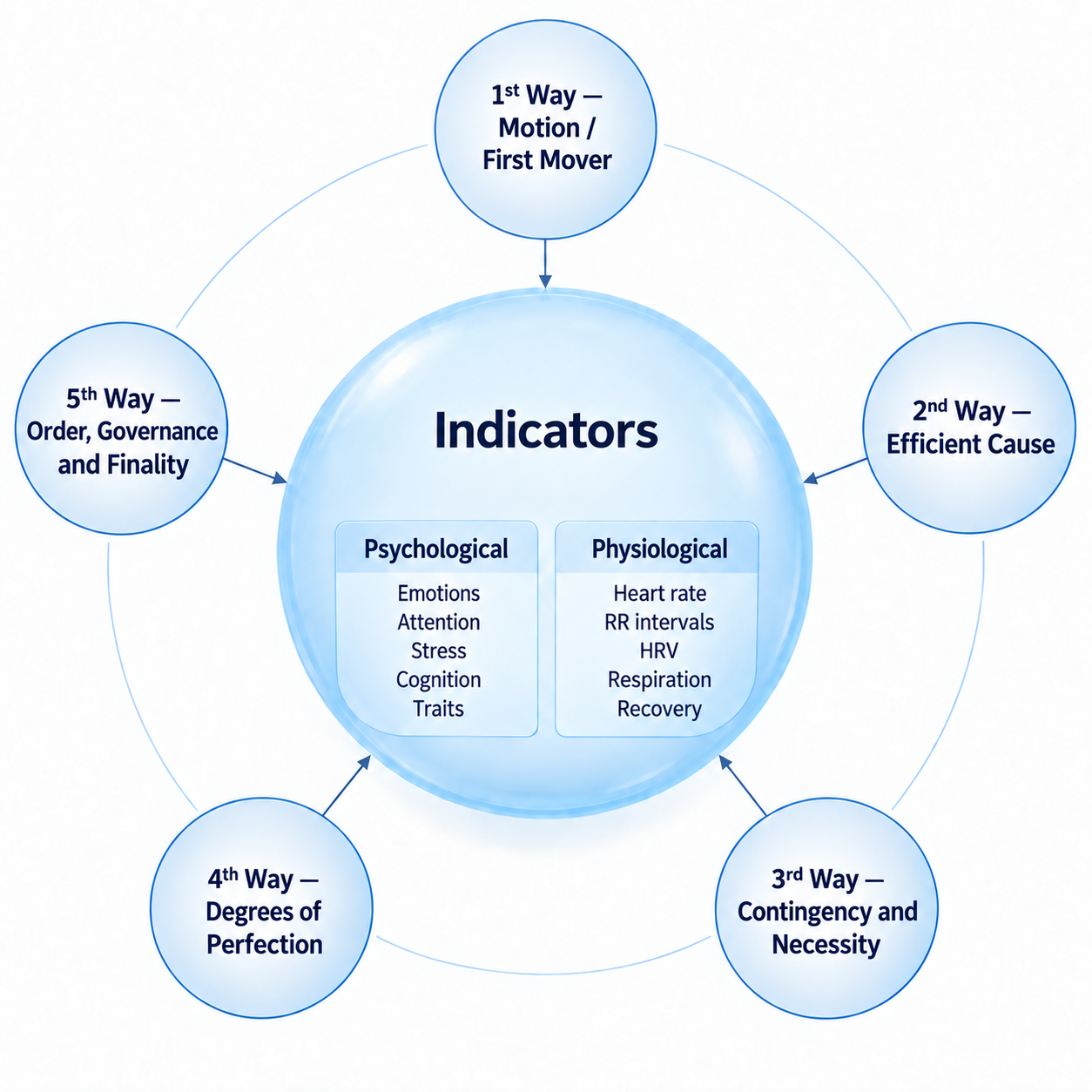
Thomas Aquinas’s Five Ways were incorporated into GoDataX Human 7 as an interpretive layer of a metaphysical nature, meant to broaden the observation of psychological and physiological results beyond their strictly measurable dimension. The five ways considered are: the 1st Way, Motion or First Mover; the 2nd Way, Efficient Cause; the 3rd Way, Contingency and Necessity; the 4th Way, Degrees of Perfection; and the 5th Way, Order, Governance, or Finality.
Using these perspectives is not meant to scientifically validate metaphysical propositions or turn psychological or physiological indicators into evidence of a spiritual nature. Their role is to offer a complementary interpretive framework, allowing the data to be observed through questions related to motion, causes, dependencies, transformations, the different degrees identified, and the possible order or finality present in the phenomena analyzed. In this way, the Five Ways function in the project as a philosophical and metaphysical framework for observation, linked to the psychological and physiological analyses, while always preserving the distinction between scientific evidence, philosophical interpretation, and metaphysical hypothesis.
Whatever is moved is moved by another.
— Thomas Aquinas, Summa Theologica, I, Q.2, Art.3
| # | Latin | English | Argument type | Conclusion |
|---|---|---|---|---|
| 1 | Prima Via | Argument from Motion | Cosmological | First Mover, itself unmoved |
| 2 | Secunda Via | Argument from Efficient Cause | Cosmological | First Efficient Cause |
| 3 | Tertia Via | Argument from Contingency | Cosmological | A being necessary in itself |
| 4 | Quarta Via | Argument from the Gradation of Being | Ontological/axiological | The maximum being, cause of goodness, truth and perfection in all things |
| 5 | Quinta Via | Argument from the Governance of the World | Teleological | An intelligent being directing all natural things to their end |
Each row also stores, in full, the premise, the metaphysical principle invoked, the step-by-step reasoning, and the exact conclusion wording, plus a SOURCE_REFERENCE pointing back to Summa Theologica I, Q.2, Art.3.
The Septenary Constitution, not the chakra system, was chosen as the philosophical counterpart to the Five Ways, for one structural reason: the Five Ways are pure philosophical argumentation, act and potency, efficient causation, contingency and necessity, degrees of being, final causality, a Western model of levels of reasoning, which the septenary ladder mirrors step for step. Read top to bottom, the resulting mapping traces an ascending line, Lower Mental → Lower Mental → Higher Mental → Higher Mental → Buddhic, which reproduces a well-documented observation about the Five Ways themselves: they run in increasing order of abstraction, from reasoning about sensible motion (way 1) to recognizing intelligent purpose (way 5). None of the five ways is assigned to the Atmic/Spirit level, all five converge on the same conclusion (“this all men speak of as God”), which corresponds to level 7 as their shared destination, not as a property of any single way’s reasoning process. This is a conceptual, qualitative reading, not a historical claim about what Aquinas intended, the septenary constitution postdates him by roughly six centuries and belongs to a different intellectual tradition (19th-century Theosophy) entirely.
Why the Septenary Constitution, not the Chakras
Both the Septenary Constitution and the chakras already had a GDX_PSY_*-linked catalog table in the project, so either was a structurally valid target for a second relation table. The Septenary Constitution won for one reason: the Five Ways are pure philosophical/metaphysical argumentation, a Western model of levels of being and reasoning, and the Septenary Constitution is exactly that kind of model too (physical → vital → astral → lower mental → higher mental → buddhic → atmic), which gives a natural, non-forced correspondence. The chakra system, by contrast, is primarily a model of embodied/energetic centers (yogic physiology), it has no natural counterpart for a step-by-step syllogistic proof: only two of the seven chakras (Ajna/intuition, Sahasrara/union with the transcendent) would have anything to map to, and the three cosmological ways (motion, efficient cause, contingency) would have no defensible chakra at all. Forcing that mapping would have been considerably weaker than the one below.
Relation table: Five Ways × Septenary Level
| Way | Septenary level (GDX_PSY_SEPTENARY_LEVEL) | Justification | Confidence |
|---|---|---|---|
| 1. Prima Via (Motion) | 4, Lower Mental Body | Reasons about concrete, observable change (motion/potency-to-act) in sensible bodies, practical, this-worldly causal reasoning, not yet an abstract value-judgment or an intuitive grasp of purpose | MEDIUM |
| 2. Secunda Via (Efficient Cause) | 4, Lower Mental Body | Reasons about an observable causal chain in the world of things, concrete cosmological reasoning, still at the level of practical/concrete mind | MEDIUM |
| 3. Tertia Via (Contingency/Necessity) | 5, Higher Mental Body | Reasons about the abstract modal categories of contingency and necessity of being, a judgment about the very status of existence, characteristic of abstract mind rather than concrete observation | MEDIUM |
| 4. Quarta Via (Gradation of Being) | 5, Higher Mental Body | Explicitly reasons from degrees of goodness, truth and nobility, a value-laden abstract judgment, exactly the function the septenary reference table attributes to the Higher Mental Body (values, long-term judgment, identity) | HIGH |
| 5. Quinta Via (Teleological) | 6, Buddhic Body | Recognizing purpose/design/order in nature is an act of grasping meaning beyond mechanical description, the defining function of the Buddhic level (intuition, existential meaning-making) | SPECULATIVE |
Why level 7 (Atmic Body/Spirit) has no row: all five ways converge on the same conclusion, “this all men speak of as God”, which corresponds to level 7 as the shared destination of the whole Quinque Viae, not as a property of any single way’s reasoning process. Assigning level 7 to any (or all) of the five rows would have been trivially true for every way and would have made the relation uninformative, the interesting structural claim is about the ways’ differing methods, not their common object. If a future need arises to record that shared convergence explicitly, the natural place is a note on GDX_TA_WAY itself (e.g. a SHARED_CONCLUSION_LEVEL reference), not a sixth row in this relation table.
Methodological caveats
| Caveat | Detail |
|---|---|
| Confidence reflects wording match | MEDIUM/HIGH/SPECULATIVE reflects how directly each way’s stated reasoning matches the septenary level’s own definition. Way 4 scores HIGH because its language (goodness, truth, nobility) is almost verbatim the Higher Mental Body’s definition; way 5 scores SPECULATIVE because “recognizing design” as a Buddhic/intuitive act is a much freer interpretive leap than the others. |
| Ways 1 and 2 share a level | Both COSMOLOGICAL, both level 4, argued identically in structure (observe an effect → deny self-causation → deny infinite regress → posit a first term), and were given the same level for that reason. A future revision could split them by the metaphysical machinery each properly employs (motion/act-potency for way 1 vs. causation proper for way 2), not by level. |
| No empirical or textual evidence | Nothing ties Aquinas’s Quinque Viae to any theory of consciousness levels, the bridge, as with the SPSS and chakra mappings elsewhere in the project, is a GoDataX organizational device, not a scholarly finding. |
The Five Ways relational model
The Five Ways layer follows the same pattern as the Septenary Constitution: a fixed catalog of the five ways (GDX_TA_WAY) linked to GDX_PSY_SEPTENARY_LEVEL through a dedicated mapping table, so the philosophical layer stays cross-referenced to the psychometric schema without touching it directly.
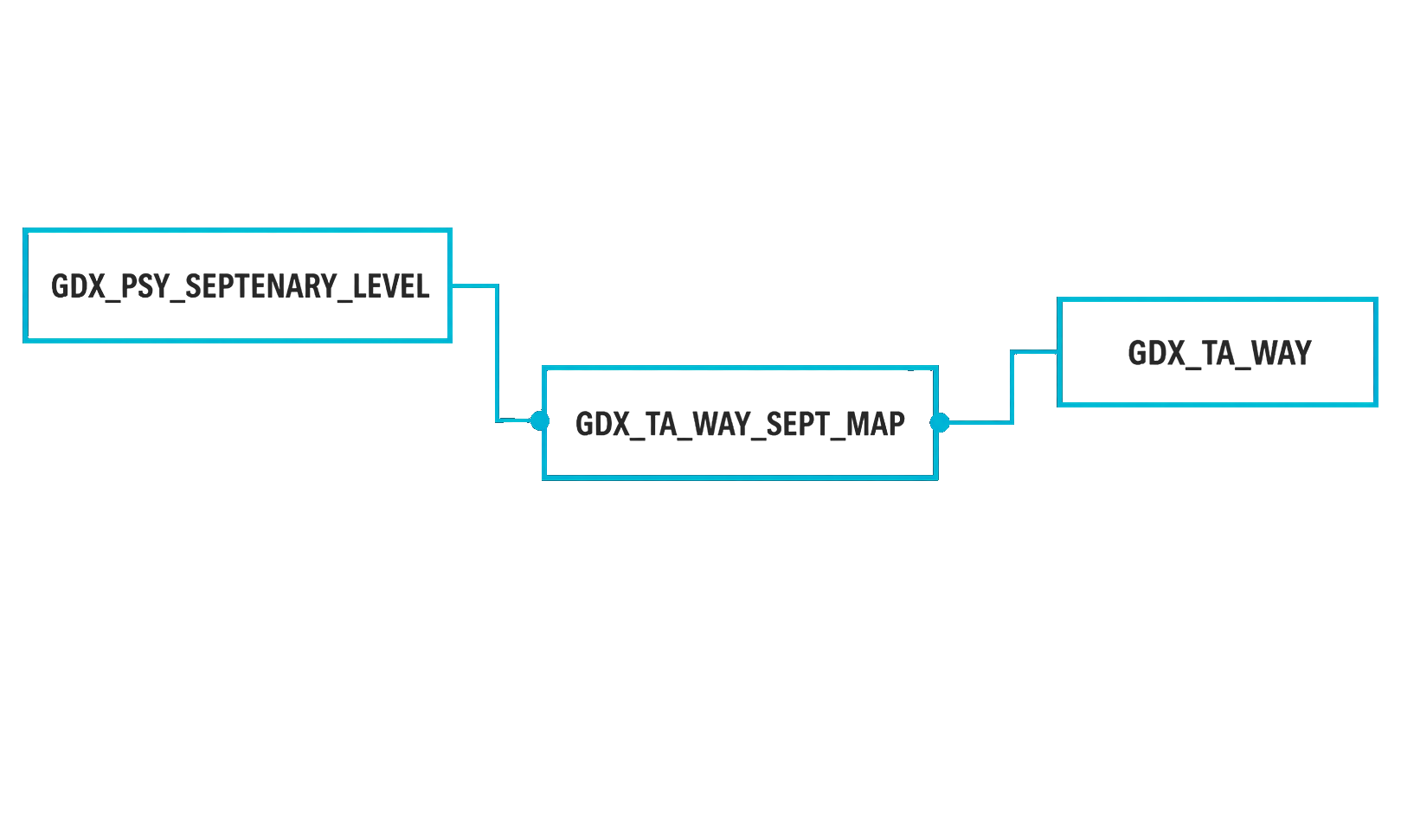
GDX_TA_WAY relational model behind the Five Ways layer.This is an excerpt covering the metaphysical bias of the instrument. Read the full article, GoDataX Human 7: A Multidimensional Measuring Instrument for Human Evolution, for the psychological, physiological, philosophical, energetic and remaining sections.